2. Dynamics of the contemporary food systems
The industrialization of the food supply
The configuration of any food system [1] is determined by the articulation of different forms of agricultural production (Chapter 4), the processing and distribution of the food supply (the focus of this chapter), and food demand (Chapter 6). It is closely linked to the technical, social and economic dynamics that permeate societies.
The history of food supply has been shaped by technological and economic developments that have influenced the ways in which food is produced and distributed, as well as its nature, origin and the ways of accessing it. This chapter looks at four major trends with a more or less long history: the intensification and juxtaposition of these trends over the nineteenth and twentieth centuries led to the emergence and dissemination of an industrial agri-food model [2] We focus specifically on technological changes in the way our food is processed, the globalization of trade, the concentration of stakeholders in the agri-food industry and the boom in digital technology. Ultimately, this chapter seeks to nuance the widely held belief that the contemporary food system was built in stages – linearly over time – and that it is converging towards its final stage, founded on an industrial model.
Technological developments in food processing
For hundreds of thousands of years, humans have implemented a range of methods to process all or part of their food resources for the purpose of extracting their edible components, slowing down or controlling their degradation, ensuring their safety or digestibility and improving their organoleptic properties. The first food processing operations date back to prehistoric times, which were already characterized by the use of processing tools (stone or wooden), the cooking of food in connection with the domestication of fire and the application of fermentation methods (Hutkins, 2018; Sinsheimer, 2018). For instance, as early as the seventh millennium in China, there is evidence of the production – in clay jars – of a fermented beverage made from rice, honey and fruit (hawthorn and grapes), which had a social, religious and medicinal function (McGovern et al., 2004).
Food processing was long a manual domestic activity handled mainly by women. The first processing operations – cereal threshing, seed grinding and pressing – served to separate edible from inedible components and to prepare products for storage. With the advent of water and animal power, the first mechanized processing operations appeared, leading to the emergence – at different times around the world – of specialized craft activities, often carried out by men who became millers, pressers, dryers, slaughterers and other food processors (Sigault, 1993). During Antiquity, in parallel with domestic cooking, ‘secondary processing’ (from flour to bread and pasta, from crude to refined oils, from carcass meat to cut pieces etc.) became more professionalized. There is evidence that specialized staff – brewers, bakers, butchers, pastry makers and other culinary professionals – worked in ancient Egyptian palaces (Bresciani, 1999).
With the Industrial Revolution came significant developments in technical food processing systems, particularly as a result of advances outside the food industry (Birlouez, 2019). Progress in various scientific disciplines (thermodynamics, biology, chemistry, physics, mechanics and materials science), the development of process engineering, as well as the rise of computer science and electronics from the twentieth century all contributed to the emergence of the agri-food industry. The discovery of appertization (canning) in 1795 and the invention of the ammonia refrigeration machine in 1858 heralded a major revolution in food preservation. Building on the scientific advances of the nineteenth century, the following century was marked by the invention of a host of new technologies: food irradiation (1905), freeze-drying (1906), high-pressure processing (1910), rapid freezing (1929), microwaves (1947), milk ultrafiltration (1969) and others.
In processing plants, step by step, the use of low-cost fossil fuels, the development of automation and the rationalization of work helped boost production rates while reducing post-harvest losses. This revolutionized food processing, preservation and traceability – the mass, standardized production of industrial food began, driven by economies of scale and long-distance transportation, which in turn enhanced food hygiene and shelf life.
At the same time, the food industry was also changing in step with advances in food science, especially with the implementation of a two-stage food processing approach (Soler et al., 2013). Raw materials – which were becoming increasingly standardized and more competitive in the upstream agricultural sector – were processed to extract simple ingredients such as sugar, flour, fats, fruit purées, milk proteins, starch, carrageenan and so on. These ingredients, derived from different processing operations, were then used to make finished products with new organoleptic, nutritional or preservative properties. This food reconstitution process sometimes required the use of additives, including texture, colour and taste enhancers, which could be natural – for example, soya lecithin, turmeric or starch – or chemical – for example, aspartame. This approach was pushed to the limit with the manufacture of so-called ultra-processed foods, which now dominate the food supply in high-income countries [3] (Monteiro et al., 2013).
This approach is illustrated by the hourglass in Figure 5.1. Working with a certain range of agricultural raw materials, a handful of intermediate products and new processes can be used to manufacture a multitude of novel processed end products (Soler et al., 2013) to meet ever-changing consumer expectations (Chapter 6).
Food supply diversification is not limited to opportunities afforded by technical developments in processing methods. Industrial products are linked with a growing number of tangible and intangible services: increasingly sophisticated packaging designed for new uses, information and advice shared by brands on their digital platforms, games and competitions and similar digital activities. These features help differentiate products and target ever more refined consumer segments (children, seniors, sports fans, sick people etc.), thereby giving rise to personal nutrition opportunities and thus new potential sources of added value. Hence, the raw materials in industrially produced food products account for an ever smaller share of the final product value. Coffee exemplifies this trend: when a person buys a coffee, they first pay for the beans, then for the fact that it is ground, freeze-dried and packaged in pods and capsules. Paradoxically, this means that although food product prices are rising, producers are not being paid more (Daviron and Ponte, 2005).
A pair of hourglass diagrams illustrate the flow of agro-industrial raw materials. On the left, the diagram features an hourglass shape with agricultural raw materials at the wide top and end products at the narrow bottom, connected by a small circle in the centre. Arrows point toward a box that states: increasing the use of intermediate products, additives, and innovative processes reduces the variability of agricultural raw materials, which in turn leads to greater consistency and productivity. Furthermore, an increase in end product diversity enhances the ability to meet demand. On the right side, the hourglass diagram is inverted, showing agricultural raw materials at the narrow top and end products at the wider bottom, with a circle in the middle marked by a dotted line.
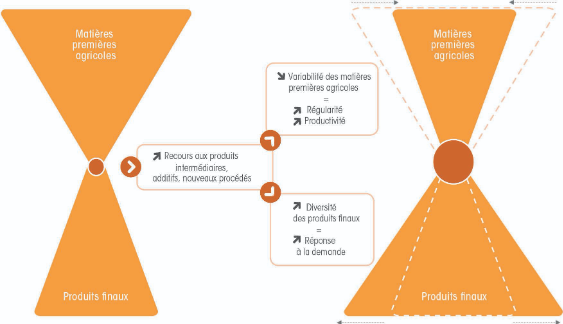
Figure 5.1. The shift of the diversification of the agroindustrial food supply further downstream through the use of intermediate goods and new processes. Diagram adapted from Gilles Trystram’s presentation ‘What food technology innovations?’ (UNESCO Chair in World Food Systems, 2014).
In addition, the industrialization of food processing has coincided with advances in logistics. The internal combustion engine and oil-based technologies revolutionized transport, speeding up its development and reducing its cost. Agricultural raw materials upstream and finished products downstream can now be transported far beyond their production areas. The development of cold-chain processes has also enhanced the transportation of fresh produce. These advances have been essential to long-distance trade, mass distribution and out-of-home catering. The domestic use of certain technologies, such as refrigerators (from the 1930s) and microwaves (from the 1970s), created new opportunities for innovation in the food processing industry. Together, these technological developments in food processing and preservation have fostered growth in production volume, greater food availability across space and time, cost savings through economies of scale and, above all, the diversification of the food supply.
Finally, the food supply influences consumption patterns while also being responsive to changing lifestyles. Food innovations do not suddenly emerge, nor do they affect everyone – the dynamics of the prevailing gastronomic value system may dictate how slowly or quickly they are adopted (Flandrin, 1989) (Chapter 6).
Trade globalization
While trade globalization has intensified since the nineteenth century (Marnot, 2012), it dates back to much earlier times. Recent studies have shown that Asian foods were already being imported into the Mediterranean Basin as far back as the Bronze Age, 4,000 years ago (Scott et al., 2021). More recently, in the sixteenth century, potatoes, tomatoes and maize were brought to Europe from Latin America, gradually expanding the variety of foods eaten by Europeans as well as by Asians and Africans (Mendes Ferrão, 2005; Fumey and Raffard, 2018). Food products were sometimes the drivers of exploration voyages to discover novel ingredients such as spices and stimulants. Breakfast – which in Europe is a combination of tea, coffee, chocolate and sugar – is a clear illustration of the fact that ‘the world [has long been] in our cups’ (Mintz, 1986; Grataloup, 2017). In Europe, in the fourteenth and fifteenth centuries, around three quarters of bourgeois and noble cuisine dishes featured large quantities of more than fifteen spices. The French subsequently came to neglect spices from the sixteenth century, with the exception of pepper, cloves and nutmeg (Flandrin, 1989). It was not just food that travelled; culinary techniques were also exchanged and enriched (Gassie, 2017). For instance, in the sixteenth century, cassava was introduced to the Gulf of Guinea region of Africa, along with the Brazilian technique for processing it into fermented semolina. The Beninese dish gari was thus inspired by the Brazilian dish farinha (Muchnik and Vinck, 1984).
This trade is also driven by the urbanization of our planet. Historically, with the exception of fresh produce grown in the vicinity of suburban areas and cities with a flourishing breadbasket hinterland (e.g. Paris and the Île-de-France region in France), urban areas were supplied in part through long-distance trade. In the fifteenth century, cities such as Venice and Genoa, located by the sea or inland waterways, imported wheat from Egypt. Amsterdam did the same with imports from Ukraine. But as Fernand Braudel points out:
It matters little to them who produces [the food] and the archaic or modern way it is produced [ . . . ]. Most, if not all, of the primary sector necessary to ensure their subsistence and even luxury standards are mainly outside [the cities], and work for them without them having to contend with the economic or social difficulties surrounding production (Braudel, 1992). A few major cities, such as Angkor and Alexandria, were outliers in this regard: it was not the food there that came from afar, but rather the fertilizers. These cities were located close to agricultural areas enriched by fertilizing alluvial deposits percolating from distant upstream watersheds (Evans et al., 2007; Viollet, 2007). This highly productive land produced surplus crops that could feed city dwellers employed in the construction of temples.
From the second half of the nineteenth century, long-distance trade accelerated. The steady increase in fossil fuel use reduced the cost and time of sea and road transport, while the introduction of quality standards enabled people to obtain goods through long-distance purchases without having to actually see them. This latter mechanism in turn facilitated the development of futures markets for agricultural raw materials (Chapter 4). As part of the market expansion process, standardization embeds companies in global value chains comprising networks of international private or private–public actors. Moreover, standardization helps companies meet multiple objectives, such as compliance with hygiene and health safety regulations (with the development of standard methods like the HACCP [4] standards system, for instance) or the implementation of commercial differentiation strategies through the creation of labels for products meeting precise specifications – registered designations of origin, protected geographical indications, private brands and so on (Lamanthe, 2007).
This food standardization process is intensifying competition within agricultural sectors, as products such as cereals, oilseeds, coffee, milk powder and sugar can all be traded on the same market irrespective of their origin. A growing number of countries are able to take part in this trade depending on their comparative advantages. This expansion is helping to stabilize agricultural prices, which are inherently volatile due to irregular crop harvests – the inevitable risk of an exporter defaulting after a poor harvest may be offset by the performance of another, better-off exporter. Yet futures markets and their speculative contracts have also heralded the arrival of financial players in the food trade, with the risk of generating speculative bubbles such as the one that fuelled the surge in food prices in 2008. Speculation by merchants has always been rife in agricultural markets whenever stockpiling was possible, but the scale and scope of this phenomenon changed markedly with the advent of economic globalization and financialization.
A concentration of actors
This dual trend of replacing human labour with machines and growing market financialization is contributing to the reconfiguration of food system actors. What started as a decentralized patchwork of small-scale commercial activities – initially rural and then increasingly urban – is giving way to larger and more concentrated companies, with the rise of the giant multinational corporations that prevail today: Nestlé, PepsiCo, Unilever, Coca-Cola, Mars, Mondelez, Danone, General Mills, Kellogg’s, Associated British Food and so on. It is thus estimated that the top ten food and beverage companies account for 37.5 per cent of the market share of the world’s hundred leading food companies (IPES-Food, 2017). However, these companies account for only a quarter of total sales across the entire industry. Concentration is far higher in agricultural supply sectors – particularly for pesticides – where the top ten companies have captured 80 per cent of the market (Rastoin and Ghersi, 2010).
As the sector becomes more concentrated, its market structure is moving towards an oligopoly-fringe model (Rastoin, 2012) – a few leading firms dominate, with smaller operators (micro-, small- and medium-sized enterprises, on-farm processors etc.) filling the market gaps. Power is concentrated among a handful of giant companies that use their massive influence to shape and implement public policy in their favour.
Yet we should not limit ourselves to an ‘evolutionary’ typology of the actors involved, going from ‘rural and traditional’ actors to large ‘consolidated industrial’ companies (HLPE, 2017; Johns Hopkins University and GAIN, 2021), which would imply that small businesses are doomed to disappear and make way for larger ones. More often than not, interactions between micro-, small-, medium- and large-sized companies are competitive or complementary (Gasselin et al., 2023). Moreover, new business forms are emerging in response to purely capitalist dynamics, for instance, within the social solidarity economy (Chapter 20). They are also prompting conventional companies to innovate to meet social sustainability challenges (Boltanski and Chiapello, 2005).
In the late twentieth century, a new actor emerged and became increasingly powerful: mass retailers. This sector, which initially focused on retail (supermarkets and hypermarkets), has expanded into a range of areas – logistics (platforms), competing with wholesale markets; processing, with the development of private labels; and the banking sector, with consumer credit offers. Supermarkets and hypermarkets are springing up almost everywhere worldwide, in step with the rise of the middle class (Reardon et al., 2003). Competition between suppliers and upstream producers in this sector has increased as a result of operator concentration and globalization.
With the advent of mass conventional and digital retail, competition between products displayed on the same shelf or web page is intensifying. Marketing and communication are now crucial to business strategies. Brands have become virtual substitutes for products – in other words, the symbolic prestige of the brand transcends the actual tangible features of the product. Merchandising, packaging and advertising are all ways to make a product stand out from the competition (Cochoy, 2002). A product’s reputation thus precedes its use. On supermarket shelves, consumers now find product information on the packaging, which has superseded interpersonal relationships with shopkeepers. Hence, major agri-food groups are seeking to gain knowledge of their customers and get closer to them by enlisting marketing professionals. Meanwhile, the concentration of mass-market retailers is increasing the power imbalance within the food industry. These retailers’ payment terms enable them to invest the cash flow generated by consumer sales, which in turn allows them to operate with relatively narrow commercial margins and thus to offer highly competitive prices.
Finally, there are more and more intermediaries, and the chain between producers and eaters is lengthening. The food system is no longer confined to the actors directly working with food products. The role of suppliers of equipment and intermediate inputs and services (energy, packaging, digital solutions) is also steadily growing. An entire economic sector now indirectly supports companies that produce and market food products (research, studies, consultancy, insurance, finance, communication etc.). As these facilitation services professionalize, they are also increasingly engaging with a diverse range of food and non-food sectors.
The rise of digital technology
Since the late twentieth century, food systems have increasingly been incorporating digital economy tools and operators. Digital technology is transforming all stages of the food system – from agricultural production to meal ordering – in terms of both the way they operate and the configuration of the networks of actors involved.
On a global scale, digital technology has been bolstered by the development of satellite and airborne imagery (via drones), delivering increasingly precise geographical information that enables users to calculate the size of a population, its movements and living conditions, and even to estimate the extent of poverty (Jean et al., 2016). In the agricultural sector, satellite imagery is used on more localized scales to map agro-climatic indicators that may be useful to farmers. These maps enable farmers to fine-tune the management of their farming operations. Pesticide suppliers, for instance, propose digital applications in combination with agricultural machinery to optimize the use of inputs (GRAIN, 2021). These tools also serve to record farming practices and thus report on production conditions. This facilitates the certification of compliance with specifications without the need for costly visits from an agency to monitor a farmer’s practices – provided the farmer is able to invest in this new digital equipment. This monitoring also extends to workers. It is now possible to precisely track, and therefore control, these workers’ movements and activities through smartphone location tracking – a process that is already implemented in online retailers’ warehouses.
Blockchain – a shared database that allows for any transaction to be recorded without the risk of falsification – a technology initially developed for the Bitcoin cryptocurrency, is now being used for land titles and product traceability (Tian, 2016). Its high level of tamper resistance removes the need for central control agencies. This trend is paving the way for greater traceability of product origin and routing, though it is of course contingent on the standardization of product quality.
The greatest impact of the rise of digital technology is likely to be on distribution and consumption. First, it is shaping online food product ordering practices. The recording of food references in databases used to fill the virtual shelves of online ordering sites makes it considerably easier to compare products within the same category, thus paving the way for comparative rating systems that offer better consumer advice. The composition of food products and the conditions under which they are produced are now more easily identifiable, thus making them key areas of competition for businesses. Online shopping is also giving rise to new purchasing practices. It provides access to online ratings or comments, which shoppers can use to assess the reputation of different products or manufacturers. However, the lack of oversight of these participatory systems means that this information can be adulterated. For instance, companies can purchase pseudo-user reviews to promote their products or undermine the reputation of competitors (Casilli, 2019).
The growing use of computers, tablets and smartphones for online information, shopping and payment has facilitated the collection of information on consumers’ interests, purchases, movements and sometimes health, and – through nanotechnology – perhaps soon even their live physiological state (blood sugar, blood alcohol content etc.). The arrival of smart food processors and fridges in households is also enabling the collection of data on domestic practices. These data can be analysed to draw up consumer profiles – so-called profiling, which is valuable to businesses – and to advise consumers directly, offering them suggested products or personalized recommendations.
Messaging applications and video chats on social networks are used in various ways in the food industry, including the sharing of advice, testimonials (e.g. so-called grocery haul posts on online video sites), information and tutorials on products, shops, cooking, nutrition and religious and ethical practices. This has led to the emergence on social networks of ‘food influencers’ (Zirari, 2017) whose videos are widely viewed. Social networks are also used to advertise, sell and order products or ready-made meals within a customer network (Chapter 16). This commercial avenue allows people to buy food directly from farmers or ready-made meals from semi-professional, work-from-home chefs.
The rise of digital technology seems to be a continuation of the ever-increasing standardization of products and a means of streamlining and saving time, thus furthering the food system industrialization process. At the same time, private individuals are mobilizing this technology to share knowledge, practices and innovations via potentially copyright-free processes (IPES-Food, 2017; Hérault et al., 2019) (Chapter 18). Such sharing takes place outside, and sometimes even in opposition to, capitalist markets while generating new forms of social ties.
Conclusion
All of the trends described in this chapter have contributed to the industrialization of the food supply and the commodification of food. First, the social perception of food is changing: in our collective imaginary, it is gradually being stripped down to its commercial market attributes (price, convenience, image), to the detriment of its cultural, health, environmental and ethical dimensions, which are regarded as externalities at best. Second, the management of food systems has been entrusted to a hybrid form of governance by public authorities and the private sector, ultimately excluding citizens (Vivero Pol et al., 2020) (Chapters 18 and 22). However, contrary to the idea of a ‘triumph of mass consumption and the capitalized and internationalized agro-industrial system’ suggested by Louis Malassis (1997), the rise of this kind of food system does not preclude other forms of food organization – it combines with, shapes and draws inspiration from these forms of organization rather than replacing them. While digital technology is gaining ground and offering new opportunities for industrial actors, it is also a counterbalancing force used in alternative initiatives. Despite trade globalization, the food system industrialization process is far from being a reality everywhere. In all regions of the world, food-consumption patterns combine local and distant production, as well as raw produce and industrially processed food (Chapter 6).
[1] As defined by Louis Malassis (1994), this refers to ‘the way in which people organize themselves in space and time to obtain and consume their food’.
[2] Rastoin and Ghersi (2010) refer to the ‘agro-industrial model’, with the prefix ‘agro’ referring more to agriculture and the production of agricultural raw material than to food processing, marketing and distribution operations and actors further downstream, which the term ‘agri-food’ is deemed to denote more accurately.
[3] Yet these foods are also becoming widely available in low-income countries, particularly in Southeast and East Asia.
[4] Acronym for ‘Hazard Analysis Critical Control Points’, an analytical system for monitoring food hazards.