Policy Briefs
So What? This is a series of policy briefs released by the UNESCO Chair in World Food Systems that aims to translate research results into clear findings for action.
It seeks to cover all areas of sustainable food: from nutrition to the right to food, including marketing, social sciences and management, political science, economics, agrifood technologies and agronomy.
This series is intended for anyone who is curious and "savvy" and wishes to know more about recent research advances in the field of sustainable food. The Chair intends to contribute to dialogue between research and various food system actors.
So What | N°14, february 2021
Urban food innovations – scaling and social inclusion issuesJust over half of the world’s population lives in urban areas. By 2050, this figure is expected to rise to two-thirds. Cities, where little food is produced, concentrate and exacerbate food sustainability issues.
So What | N°13, january 2021
Can community gardens promote more sustainable lifestyles?With over 70 per cent of the European population living in towns and cities, there is an urgent need to promote sustainable urban development that ensures the health and inclusion of communities, the protection of the environment and economic development. Urban green spaces are recognised as an essential element in the design of sustainable cities.
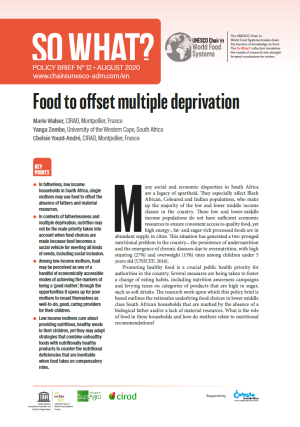
So What | N°12, august 2020
Food to offset multiple deprivationIn South Africa, many social and economic inequalities are a legacy of apartheid. They particularly affect black, mixed-race and Indian communities, who make up the majority of the socio-economic middle and lower classes. These communities have limited financial resources, which prevent them from having consistent access to good-quality food.
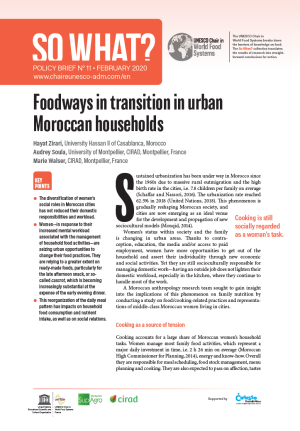
So What | N°11, february 2020
Foodways in transition in urban Moroccan householdsSince the 1960s, Morocco has experienced sustained urbanisation due to a massive rural exodus and a high birth rate in cities: an average of 7.8 children per family (Schaffar and Nassori, 2016). Its urbanisation rate reached 62.5 per cent in 2018 (United Nations, 2018).
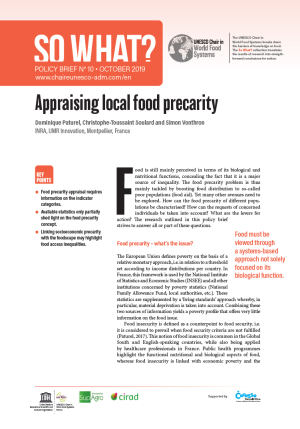
So What | N°10, october 2019
Appraising local food precarityFood is one of the most invisible sources of inequality, as it is still largely viewed in terms of its biological and nutritional function; this leads to the problem of food insecurity being addressed primarily through the distribution of food to so-called poor populations (food aid).
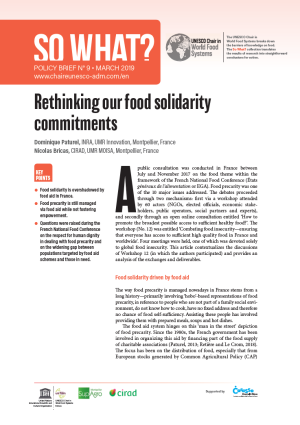
So What | N°9, march 2019
Rethinking our food solidarity commitmentsBetween July and November 2017, a public consultation was held in France on the topic of food: the États généraux de l’alimentation (EGA). Of the ten key issues addressed, one concerned food insecurity.
So What | N°8, october 2018
Is it relevant to talk about ‘alternative’ agrifood networks?Research in rural economics and sociology uses the terms ‘alternative agri-food networks’ and ‘alternative food systems’ to encompass initiatives as diverse as fair trade, organic farming, short supply chains and local produce.
So What | N°7, september 2018
How Chinese urban families symbolically perceive and consume commercial drinksFrom the 1980s onwards, China embarked on the path towards becoming a consumer society. This trend has continued, with growth accelerating sharply from 1995 to the present day, although certain signs of a relative slowdown and stabilisation have been observed since 2008 (Desjeux, 2012).
So What | N°6, november 2017
Sensory pleasure and mindfulness, allies of a healthier dietThe thermometer reads 30 °C; you’re thirsty and you’re revelling in the thought of drinking a nice cold lemonade. In fact, the same areas of the brain are activated whether you’re actually drinking it, imagining doing so, or watching someone else do it.
So What | N°5, october 2016
Looking at mothers differently to understand the feeding of children betterAnaemia and malnutrition are a major public health problem in Côte d’Ivoire. In 2008, iron-deficiency anaemia affected 81 per cent of children under the age of five and 59 per cent of women of reproductive age in the north of the country, as well as 75 per cent of children under the age of five and 68 per cent of women of reproductive age in Abidjan.