4. Discussing the watchwords of sustainable food systems
Active consumers as drivers of change?
Individual behaviour has an impact on the sustainability of food systems. The quantities one consumes, the composition of one’s diet – with more or fewer animal or processed products – and the choice of foods based on the way they were produced, as well as product purchasing, cooking and waste management practices, all influence one’s health, the environment and social equity. Industrialized societies, where the food supply increased and became more diverse over the course of the twentieth century (Chapter 5), have reached levels and styles of consumption that cannot be generalized to the global population at the risk of far exceeding all ‘planetary boundaries’, several of which have already been crossed (Chapter 7).
In response to this situation, the United Nations’ (2021) sustainable development goal 12, ‘Sustainable Consumption and Production’, calls for the adoption of consumption practices that support a ‘more sustainable future’ by ‘doing more and better with less’. This chapter discusses different levers for influencing individual consumption and behaviour. It particularly addresses the common idea that consumers are a powerful driver – if not the main driver for some – of these necessary changes.
Consumer responsibility
The sovereignty or responsibility of consumers or ‘active consumers’, responsible or activist consumption (Dubuisson-Quellier, 2009), boycott and buycott(Friedman, 1996) and political consumerism (Micheletti et al., 2004) have become watchwords for the transition to sustainable food systems. This can be seen as a neoliberal approach to change, which advocates reducing the scope of state intervention and defends individual freedom on the grounds that each person is the best judge of their own well-being. From this perspective, one’s economic choices are deemed effective in satisfying one’s own interests through consumption. The sovereignty of consumers in their purchasing practices underlies a form of democracy in which individuals are freed from the constraints and limits of their social and class affiliations, internalized in the form of habitus (Bourdieu, 1984). This approach regards training, raising awareness and educating consumers, while leaving them free to make informed choices, as preferable to entrusting the state with defining what is good for society. For companies, consumer choices are signals that they can use to steer their innovations and offerings. They use marketing tools to identify ‘consumer expectations’ and then measure them as ‘willingness to pay’ for new attributes. This means of action has the benefit of being inexpensive for the state: it is limited to setting a general framework and informing consumers. It is therefore not very restrictive for companies, which are to some extent free to act ‘in response to demand’. This avoids the need for states to impose rules on them and then have to enforce these rules, which always carries the risk that they will be circumvented.
Encouraging individual action also enables citizens to take action for change in a context where they have lost confidence in political action. Rather than despair over political paralysis, we may as well start ‘doing our bit’ to contribute to a more sustainable world, even in a very small way, by changing our behaviour.
Political consumerism pratices
Individual activism can take different, more or less restrictive forms. Most commonly, it involves choosing products based on their quality and the way in which they were produced and traded in particular – products certified as organic, palm oil–free or fair trade, products displaying a nutritional assessment, products of a specified geographical origin and so on. Food labelling relating to various dimensions of sustainability has developed considerably and allows companies to sell environmental, social or nutritional value added. These products are often sold at a higher price than ‘conventional’ products. Activist consumer choices can also relate to certain types of distribution and purchasing methods – for example, opting for short circuits, shopping in cooperative supermarkets or boycotting large supermarkets. Other forms of action can be more restrictive. They can involve a reorganization of food practices that is costly in terms of money, time, travel or information gathering, and they can differentiate a consumer from the social norm, for instance, when bulk buying, growing one’s own food, becoming vegetarian or vegan, or eating homemade food as much as possible (Chapter 16).
Some individual actions do not involve consumption per se – they do not play out in the market space – but rather changes in domestic practices, such as gardening for personal consumption, using shopping lists to best tailor purchases to the meals one has planned, cooking for the week, reducing the quantities consumed and sorting waste (Daniel and Sirieix, 2012).
All these individual actions constitute tactics to navigate constraints, both on the demand side – getting by with limited purchasing power – and on the supply side – making do with what is on offer. They allow people to take ownership of their diet by regaining control over their consumption. Tips and tricks to ‘make do with what you have’ are multiplying on social media. For example, ‘grocery haul’ videos and Gestion budgétaire, entraide et minimalisme (GBEM, ‘budgeting, mutual aid and minimalism’) groups bear witness to these everyday practices and acts of cultural poaching (de Certeau, 1984; de Certeau et al., 1998).
The limits of individual responsibility
The idea that the food system can be changed through individual practices alone has its limits. The first relates to the illusion of perfect consumer information and the need to recognize consumers’ cognitive limits. Not all food consumption is informed by well-thought-out choices on the part of eaters. It is partly guided by emotional processes, particularly pleasure (Jacquier et al., 2012).
Food consumption is also shaped by routines that are not consciously thought out; they can of course be interrogated but nonetheless facilitate purchasing behaviour. For example, these routines minimize the number of choices that eaters have to make, even if they know that these are not necessarily optimal routines (Dubuisson-Quellier, 2006). Furthermore, food-consumption practices can result from addictions. While there is still controversy surrounding this topic, certain food compounds such as sugar, salt and fat, along with ultra-processed products, are strongly suspected of causing physiological and behavioural addictions (Gordon et al., 2018). Similarly, portion sizes are a discrete incentive that determines the quantities consumed (Wansink, 1996) through the cognitive biases they generate (Chandon et al., 2017).
Some of the effects of consumption escape consumers’ awareness. For example, the presence of pesticides, drug residues or microplastics in food is invisible. Likewise, the environmental impact of the food production pathway is still very poorly measured and not reported to consumers due to the difficulty of doing so. The health or environmental effects of certain products (e.g. GMOs) are still uncertain. Should these effects be made visible to enable consumers to make informed choices? Or should states legislate to protect eaters from the risks associated with the consumption of these products? Other effects are better known but still controversial, sometimes due to campaigns to disparage scientific results that are inconvenient for certain actors; this is the case of GMOs, pesticides, glyphosate herbicide and ultra-processed products, for example.
The proliferation of contradictory messaging ends up sowing doubt in the minds of consumers and making the choices they have to make more difficult, especially since consumers do not necessarily have the technical knowledge to understand what is at stake and to sift through this information. This is what Claude Fischler (1990) calls ‘dietary hubbub’ and the ‘food cacophony’. More broadly, the multiplication of food products on offer, which is supposed to increase freedom of choice, generates a perverse effect that has been described as the ‘paradox of choice’: frustration grows when faced with too much choice, which makes it difficult to compare the different options and leaves the consumer convinced that they have probably not found the optimal product (Schwartz, 2005). Today, digital applications designed to assist individuals in making choices are proliferating. These applications rate products according to various sustainability criteria. But these criteria can be controversial, and their selection escapes arbitration by public authorities (Soutjis, 2020). The private nature of these technical devices thus raises questions about their legitimacy and governance.
A second limitation of changing the food system through individual practices is the resulting exclusion of a portion of consumers. Because sustainable products are often more expensive or require more knowledge to be assessed as sustainable, they remain the preserve of a fringe of the population with enough economic or cultural capital. When it comes to ‘voting with their wallets’, the more capital consumers have, the more power they possess to shape the food system; this is called plutocracy (from the Greek ploutos, god of wealth, and kratos, power).
In her book The Sum of Small Things, Elizabeth Currid-Halkett (2017) shows how this sum of small, discreet things – for example, buying organic vegetables nd fair-trade products or cooking vegetarian dishes – practised by young New York graduates and Hollywood stars signals more than an economic position: it conveys a moral superiority. The discourse of this elite and the visibility of their practices in gentrified neighbourhoods or in the media place guilt on all those who cannot afford to adopt these practices due to a lack of money, time, space and knowledge of the subject. Their inaccessibility gives rise to cognitive dissonance: individuals know what they should be doing to adopt a virtuous purchasing behaviour but cannot do so. The result is either frustration or a sense of injustice or a rejection of the values held by the elites. Scepticism ensues regarding the reality of environmental problems, seen as fads of these elites.
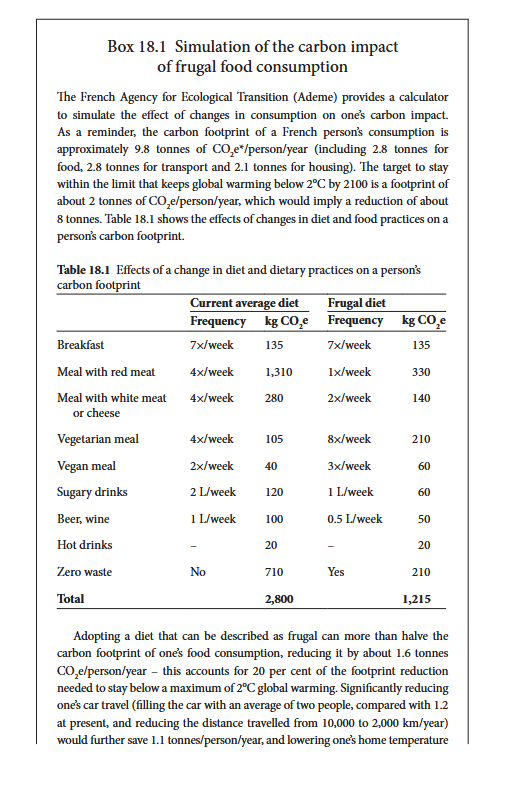
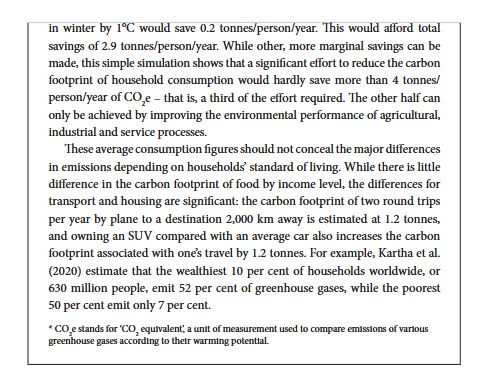
A third limitation is that household consumption accounts for only a small share of the environmental or health impacts of the entire food system. For example, adopting frugal consumption practices in a wealthy country like France contributes only to a part of the effort required to reach the target set by the Paris Agreement to limit global warming (see Box 18.1) and should not distract from the necessary resource savings required in industrial production processes.
A fourth limitation of individual responsibility is the unequal ‘ease’ of access to the food supply. This may relate to physical factors: it is easier to acquire products found locally than to make the effort to travel a longer distance. Food deserts (Cummins and Macintyre, 1999) refer to poor neighbourhoods with no local shops selling healthy food and food swamps to neighbourhoods with a high concentration of shops selling nutritionally unhealthy food. Both of these food environments, especially the latter, are suspected of contributing to the overconsumption of products high in fat, sugar and salt, which is detrimental to balanced nutrition (Cooksey-Stowers et al., 2017). If we approach price not as the result of an equilibrium between independent supply and demand but as a factor shaping demand, accessibility also has an economic dimension.
Choosing an option that is desirable but requires significant cognitive, physical or economic effort and brings only limited moral satisfaction – because its desirable attribute is non-observable (as in the case of long-term environmental or health benefits) – quickly diminishes motivation. This may explain why concern for the fairness of trade or respect for the environment is satisfied with just a few products: coffee in the case of fair trade and intermittent consumption in the case of environmentally friendly food (Lamine, 2008).
A final limit surrounding individual responsibility concerns conformity to social norms. Food is consumed not just to satisfy an individual need but also to demonstrate one’s belonging to a social group or, at the risk of being marginalized, one’s uniqueness (Chapter 1). Vegetarianism and veganism are examples of practices that are starting to be recognized as normal but are still difficult to uphold in certain cultures, particularly in situations where conforming to social norms is important (family meals and banquets, for example). Conforming to what others around oneself are doing, and thereby avoiding the burden of having to make choices, is also a way of reducing one’s mental load.
Determinants of individual behaviour
In recent years, two disciplinary fields have seen the convergence of new frameworks for analysing the determinants of individual behaviour that challenge the standard economic model of utility maximization. Informed by a new approach to health, formalized by the World Health Organization (WHO, 1986) with the Ottawa Charter for Health Promotion, the role of food environments in eating behaviour is increasingly recognized in the field of nutrition. This approach typically distinguishes between social environments, which define behavioural patterns and social norms; physical environments in living areas, which determine the conditions of access to food; and macro-environments, made up of the policies legislation, strategies and practices of the actors involved in the food supply. This model of representation has recently gained recognition, particularly from the High Level Panel of Experts on Food Security and Nutrition (HLPE) in its report on ‘Nutrition and Food Systems’ (HLPE, 2017).
In the field of psychosociology, several decades of research, synthesized in particular in Saadi Lahlou’s installation theory (2018), have led to a similar model. This model posits that the freedom of individual choice is structured by three types of installations: mental, physical and social installations.
Such models identify consumer education, information and awareness-raising as indeed necessary but insufficient to change behaviour. The example of cycling illustrates this well: explaining to individuals that cycling is good for their health and the environment (mental installation) is not enough to get them to use this mode of transport. Almost everyone is likely already convinced.
Protected cycle lanes or cycle parks must be built (physical installations) and cycling must become the social norm, with driving a car the exception if not an anomaly (social installation).
These models thus no longer place responsibility for changing individual practices on individuals alone: this responsibility must be shared with the actors who organize the food supply. Public policies that regulate food quality or incentivize companies to improve it can influence prices to encourage or discourage the consumption of certain products, regulate advertising and combat food deserts or food swamps. They therefore remain indispensable in shaping individual behaviour. We can also question the risks associated with the development of
digital tools wielded by big data multinationals for the ‘conduct of conduct’, to use Michel Foucault’s expression – in other words, to organize individuals’ self-discipline no longer through ‘external and corrective constraint applied to bodies but through desire internalized by way of suggestion, prevention and manipulation’ (Le Texier, 2011).
Conclusion
Is the sum of individual behaviours enough to change the system? The example of the boycott of Nestlé products in the late 1970s to protest against the promotion of bottle-fed infant formula as a substitute for breastfeeding (Sasson,2016) is interesting: it was organized and platformed by a political movement that was able to influence the balance of power and led to the adoption of the International Code of Marketing of Breast-Milk Substitutes. This example points to the possible risk of depoliticizing individual activism if it is not given political expression (Michel et al., 2020).
‘Voting with one’s wallet’, thus sending a signal to companies and politicians, is not the only way for citizens to voice their concerns. This form of action ultimately operates only in response to suppliers’ offerings – by buying into or rejecting them – but in no way through negotiation allowing for the co- construction of positions. Should the governance of food systems be rethought to enable citizens to take part in defining the food they want? This can be done through spaces such as citizens’ conventions, community food centres or even frameworks for agreeing on the products of a food social security system yet to be imagined. These are spaces where, through dialogue, citizen proposals negotiated with public and private actors can be developed to orient food supply, build foodscapes, define solidarity policies and establish transition pathways towards sustainable systems (see Part 5)